What Happens When You Microdose Mushrooms?
Introduction
Microdosing psychedelics has quietly become a mainstream wellness practice. But as microdosing gains acceptance, we're hitting a wall: in the race to cash in on the psychedelic renaissance, the mental health establishment doesn't know what to do with medicines that depend on consciousness expansion rather than logical reduction.
This essay explores:
Why we're stuck — The fundamental clash between Western medicine's materialist framework and psychedelics' consciousness-expanding effects, and why current approaches to legalization may be missing the point
Two possible paths forward — Creating a separate regulatory body for full-dose psychedelic therapy, or the more practical solution: legalizing microdosing within our existing healthcare system
How microdosing actually works — Four key processes that facilitate individual healing
The microdosing experience — What it feels like, how to do it safely, and why small doses offer an incremental bridge between mainstream mental healthcare and genuine soul work
Practical guidance — A detailed FAQ covering benefits, protocols, safety considerations, and common questions for anyone curious about starting their own exploration
Part I
Under The Radar: Microdosing Answers ‘The Hard Problem’ At Odds With Mental Health
Microdosing Goes Mainstream
Microdosing psychedelics has reached an important tipping point in the American mind. These controlled substances, the same ones stigmatized by previous generations—having the power to take you on a trip from which you might never return—have re-emerged as legitimate medicines for a wide range of mental health conditions, including addiction, depression, Alzheimer’s, and PTSD. Even for the most entrenched former skeptics, self-guided microdosing has steadily crept into the realm of commonplace acceptance. But now, instead of headlines about life-changing, full-dose trips, DIY microdosing has become the lead story.
Mainstream giants such as The New York Times, The Washington Post, and US News have each featured articles that chronicle this major uptick in awareness in the last few years. These articles carefully walk the line between what microdosing might promise the seeker, stating that there is overwhelmingly positive and anecdotal support for it, while also pointing to the need for double-blind placebo studies. They examine the change in attitudes across different demographics and their motivations for microdosing, and even entertain the appeal for specific niche groups like stressed out moms. In the wide ranging discussion about the risks and benefits of microdosing, major media coverage has given many newcomers a degree of license to explore microdosing in earnest.
Similar to the gradual process of recasting cannabis as medicine, successful decriminalization efforts across the country are opening up a lot of people’s minds. People are saying that microdosing is helping them with their mood, focus, creativity, as well as their mental health symptoms like depression—and instead of complaining about side effects, people are reporting that they actually feel better and are living more connected lives.
However, there’s just one big problem in opening any well-intentioned discussion about microdosing and psychedelic medicine therapy in any public forum, which is that synthetic psychedelics—as well as natural plant medicines—still remain almost totally illegal in America to this day. And so, “please insert the company legal disclaimer here _________.”
With that out of the way, the average person interested in microdosing for the first time has one sticky question to answer, which is “How do I get started safely?” And who can they turn to? Unfortunately, no scientific authority or official governing body is sanctioned to give advice on illegal activity, and so, seekers are left to begin their own research on those who’ve gone before.
How To Change Your Mind
Short on experience, most people will look to a popular authority figure for guidance. Michael Pollan’s landmark book, How to Change Your Mind (2018), provided the psychedelically curious with a tipping point moment in awareness, and a collective shift in acknowledgement. Pollan’s framework aims to flip multiple generations back to the original idea—that psychedelic medicine can shift attitudes about consciousness, like the fear of death, and facilitate healing. Pollan is quite a different messenger—an investigative journalist with a message about reconciliation with psychedelics—than Timothy Leary, the 1960s counterculture psychonaut who proposed the naive, anarchic idea that LSD was a tool for mass awakening. On the contrary, Pollan’s message is safe and resonant for those who still remember Leary and the Nixon era scare tactics that followed.
Pollan is certainly not the first expert over the last hundred years to share how psychedelics changed his beliefs, but we are a culture of star-watchers, and so if the stories of Kristen Bell or Aaron Rodgers didn’t grab your attention, there are endless numbers of celebrities who continue to reframe what psychedelics can do for their curious fans and followers.
Pollan is equally aware of the bubble of expectations and the hype he helped create. While attitudes have relaxed around the country since the release of his book and Netflix series, legally, things are much the same. Ethics and safety are also huge concerns with the proliferation of dealer-therapists and new medicine circles eyeing a profit. And finally, seeing the dollar signs, new investors have poured money into speculative psychedelic startups, believing the buzz that psychedelic medicines might be the next big thing in mental health. However, the uninitiated have learned the hard way—true psychedelic medicine therapy is highly subjective—and not scalable, at least not yet.
The Breakthrough Research
While Pollan and others mention microdosing, the main event in the science and the media to this point has been demonstrating the efficacy of full-dose psychedelic therapy. The biggest effort behind reframing psychedelics has come from Johns Hopkins, whose psychiatric and behavioral science department claims to be “leading the way in exploring innovative treatments using psilocybin.” Based on much of their research, by 2019, the FDA went so far as to call psilocybin, one of two active chemicals in psychedelic mushrooms, a “Breakthrough Therapy” for severe depression. "Breakthrough Therapy Designation” is an action meant to accelerate the sluggish process of drug development and review, and is typically requested by a drug company and granted only when preliminary evidence suggests the drug may be an enormous improvement over already available therapies. As evidence, a study presented in 2025 showed that just one full dose of psilocybin, plus eleven hours of therapy, resulted in five years of relief from clinical depression for two-thirds of patients with no relapses.
Similarly, MAPS, the Multidisciplinary Association for Psychedelic Studies, led by Rick Doblin, has presented similar breakthrough evidence with MDMA. MAPS therapies guide a patient through several full-dose journeys over a three to five week period. Instead of targeting clinical depression, MAPS has focused on serving veterans with PTSD, and for nearly four decades, MAPS has been steadily building momentum towards earning FDA approval, despite a continual uphill battle and recent setbacks in 2024. But there is room for optimism. In 2023, Australia became the first country in the world to legalize the medical use of MDMA for treating PTSD, along with psilocybin for treatment-resistant depression. MAPS is so confident in their end goal that their website asks you to “Join the Psychedelic Renaissance.” Eventually, they hope to roll out their brand of high-priced therapy centers across the country, where their clinical treatment would go for $10,000-15,000.
Another example of psychedelic healing offered in a controlled, clinical setting is Beond Ibogaine in Mexico, which presents itself as a medically supervised alternative for people seeking rapid interruption of addiction, trauma, depression, anxiety, and PTSD. The clinic emphasizes licensed physicians, cardiac monitoring, therapeutic staff, and a structured arc that moves from detox through integration. Set in Cancún, the experience includes accommodations and adjunct modalities more commonly associated with luxury retreats than addiction medicine. Ibogaine treatment does carry well-documented cardiovascular risks, placing clinics like Beond in a legal and scientific gray zone—one created less by consensus on efficacy than by the limits of current regulatory frameworks.
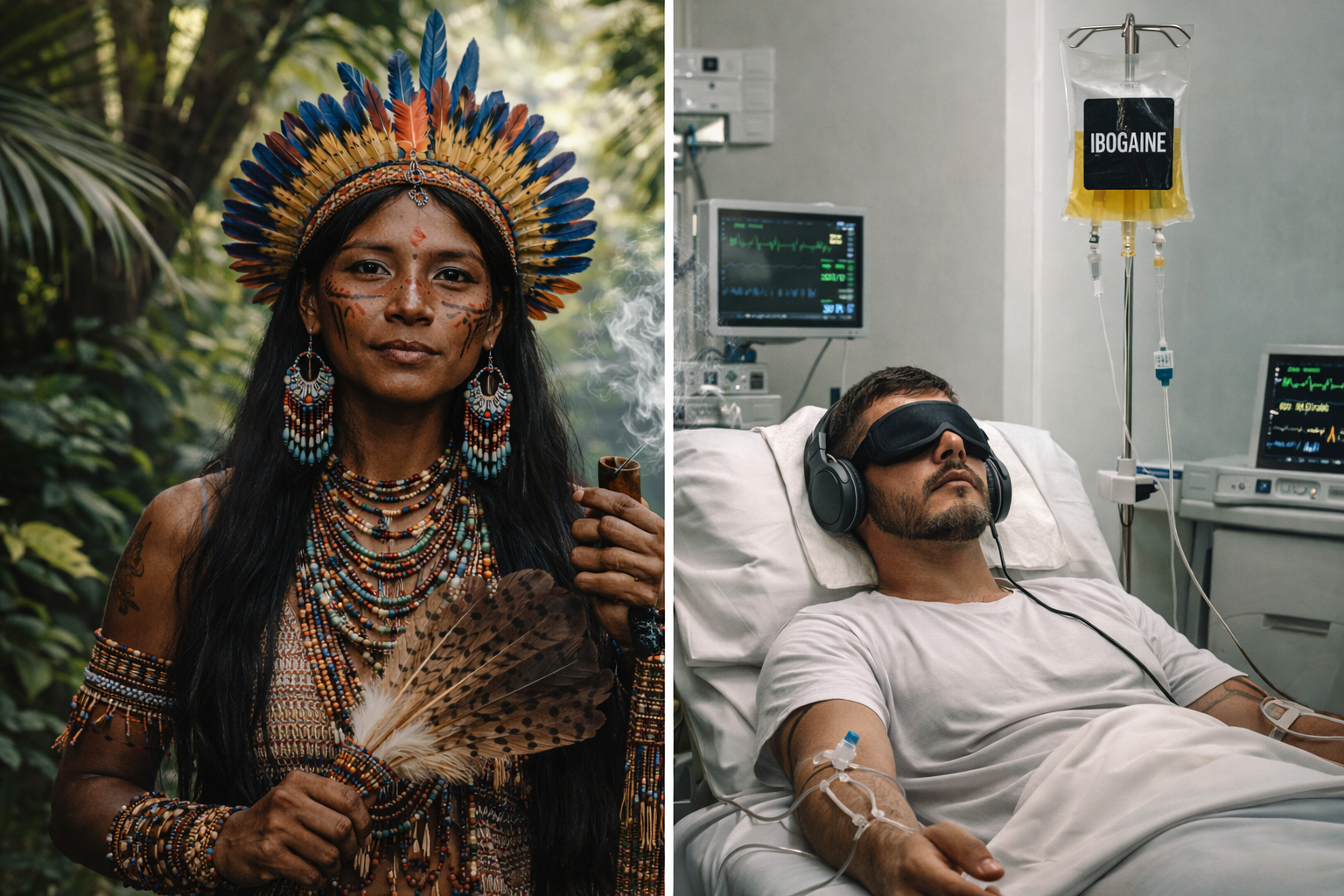
However, the results from Hopkins, MAPS, and Beond are not remarkable. For thousands of years, indigenous tribes have healed their own people—mind, body, and spirit—by administering full-doses of plant entheogens in highly controlled spiritual ceremonies, often achieving the desired outcome in just one or two sittings. Following the lure of mystical healing and consciousness expansion, ayahuasca tourism has exploded over the last decade. Countries such as Peru, Brazil, and other popular safe havens like Costa Rica offer many different experiences for the psychedelic tourist seeking “life advancement.” And so, while the clinical approach to psychedelic therapy may finally be catching up here in America, it’s more accurate to say that leading institutions are just copying and putting their twist on what already works.
Science is always copying nature. In modern psychiatry, one of the earliest breakthroughs in treating depression came with the introduction of MAOIs (monoamine oxidase inhibitors) in the 1950s. Many different MAOIs exist in medicinal plants throughout the world, the most famous of all being the ayahuasca vine—Banisteriopsis Caapi. It’s called ”the vine of the soul” or “the vine of death” in native cultures, which alludes to its healing capabilities well beyond treating depression. The vine packs three distinct beta-carbolines, MAOIs which modulate serotonin receptors and can expand awareness into a dreamy state of wonder and euphoria, but without a visual trip. The visual component that the ayahuasca admixture is famous for comes from the second plant, the DMT-carrying chacruna leaf (in most cases). Although MAOIs are still effective and underutilized for depression, they require a restricted diet, the same kind of restrictive dieta recommended prior to drinking ayahuasca in a formal ceremony. And because of this inconvenience, MAOIs began to be replaced by new anti-depressants in the 1980s that were more potenent and had no such restrictions, first by TCAs (tricyclic antidepressants), and then by SSRIs (selective serotonin reuptake inhibitors) like Prozac which debuted in 1988. SSRIs continue to dominate the antidepressant market today.
The Drugs Don’t Work
The problem with SSRIs for general anxiety and depression? It’s common knowledge that they are not nearly as effective as advertised due to a variety of factors, and over the last twenty years or so, people who’ve not had success with anti-depressants have been searching for something better. That search for ready-made alternatives is the other prime factor driving microdosing awareness: In 2016, positive reporting on microdosing began to spike—including scientific and anecdotal evidence—as noted by the sharp increase in microdosing studies and keyword searches ever since.
But even for seekers who are aware of the often miraculous and multidimensional healing powers of plants and fungi, many people can’t fly to Costa Rica for a ceremony—or simply don’t want to, and would rather just “take a pill” in an attempt to feel better, with or without some kind of ongoing therapy. And so for most people struggling with mental health, microdosing checks the boxes as a low cost, low risk experiment vs. the antidepressants that have failed to provide long-term relief.
In response, the billion dollar anti-depressant industry doesn’t seem threatened—not from high-end Hopkins research, not from expensive MAPS therapies, nor from the upsurge in micro-dosing awareness. Although naturally, Big Pharma is pumping the brakes on the wave of microdosing optimism. Psychiatrist.com broadly states that while “there is a growing positive correlation between microdosing and improved mental well being,” more studies are needed, and “due to the limited number of controlled studies and the small sample sizes in some of the studies, the causal relationship between microdosing and mental health improvement remains uncertain.”
But the ironic truth is that no one can claim to know the “causal relationship” inside any mind altering substance, or claim to know how anti-depressants actually work either. While scientists can identify chemical mechanisms and watch brainwaves do backflips on a screen, no one knows how consciousness works. But what is certain is that imitation is the sincerest form of flattery. Several startups like Cybin, now rebranded as Helus Pharma, which is “on a mission to revolutionize mental healthcare,” are formulating and testing psilocybin deuterated analogue compounds for Major Depressive Disorder, hoping to disrupt the market with signature patents or cocktails that mimic and enhance the positive effects inside the brain. In 2024, Cybin was also granted the FDA’s “Breakthrough Therapy Designation,” although the designation does not guarantee eventual approval.
Experience Dependent
With another conservative opinion, Harvard University issued what sounds like a stern warning on microdosing, pointing to a lack of scientific evidence that psychedelics are either “safe or effective,” going so far as to recommend that the reader to “speak with your doctor to explore your decision to take psychedelics.” Not surprisingly, one recent survey in Canada shows that only 18% of people actually do this—perhaps because people know instinctively that asking their doctor to comment on altered states of consciousness is unlikely to yield anything useful—on the record at least. In addition, even the most seasoned scientists agree that a psychedelic experience is quite subjective, and almost totally “experience dependent.”
“One person might have quite moderate effects, and another person might have a very profound effect on the same (full) dose,” said Doug Drysdale, CEO of Cybin. “(Cybin) aims to reduce such unpredictability to make it more tolerable for the patient and more readily integrated into treatment settings.” But how? Drysdale talks in numbers: potency, bioavailability, and duration which could potentially lead to fewer undesirable effects. But what if the unpredictable variables that drug companies seek to control are not in the drugs—but in the psyche?
Drysdale’s investor-friendly pitch implies that’s all under control—and Cybin could simply follow the model pioneered by successful ketamine clinics. He states, “Of course, drug development involves also optimizing the dose and the dose protocol and the safety envelope around the patient, and also patient selection so at-risk patients don’t get access.” Translation: In Cybin’s model, after screening, trained clinical staff will watch the patient and be ready with protocols for managing dissociative episodes in a “drug only” format which eliminates therapists and reduces costs. Basically, this means isolating the patient in a room with the drug for several hours, which is fundamentally different from MAPS therapy which relies on the presence of two therapists at all times. Here’s the problem: Psilocybin is not ketamine. It’s not a disassociative tranquilizer used in anesthesia—it’s an associative, amplified expansion to superconsciousness—but maybe to naive investors, it all sounds the same.
The Impasse
We’re now almost a decade into this new wave of psychedelic excitement, which carries the hype of revolutionizing mental health as well as some righteous motives to settle a few scores in the culture war. However, are we not instead at a familiar impasse—one where culture and consciousness collide for a stalemate, and nothing happens? Isn’t this just the familiar clash between science and consciousness, science and spirituality, or even church and state—driven by who will win the rights to monetize the outcome? The warning sign is clear: Officials on all sides of the various pharmacological, clinical, and legal agendas are all saying the same thing, which is “wait for the next trial or study to roll in, and then we’ll finally decide.” Yet more testing is unlikely to convince politicians. Broad based studies will likely see critical numbers go down, not up, and another big problem is that the intensity of a full-dose psychedelic experience can easily circumvent the designs of boilerplate studies.
Psychiatrist and psychedelic researcher Stanislav Grof echoed this practical incongruity between science and consciousness—essentially that western medicine can’t account for what it can’t measure. Ram Dass warned that the psychedelic experience was ineffable, emotionally unpredictable, and could not be reduced to clinical variables. Therefore, Western reductionism has an epistemological problem in trying to label what is essentially consciousness-shifting soul therapy—something well beyond its scope—as a “Breakthrough Therapy” for mental health. To spell it out even more clearly, a consciousness-first world view sees what is mental as an aspect of the human experience, whereas materialists reduce everything to something mental—or something happening in the brain. Furthermore, it can easily be argued that Western medicine can’t treat maladies of the soul—even if they present as physical or mental symptoms—or even if doctors ask sincere questions while playing brain chemical dominos to find solutions.
Writer Ben Brooker adds, “We have been conditioned to view mental illness as a problem of individual brain chemistry.” He suggests, “Inequality, disadvantage, and alienation—(these) issues…cannot be solved, or…spun into capitalist gold, via a pill (or a mushroom).” It’s true. In America, it’s plain to see that we’ve been conditioned to believe that poor mental health can be chalked up to a list of official symptoms, rather than something caused by the most fundamental and often extremely challenging conditions of human life. But here’s the shift: While mushrooms probably cannot be spun and scaled into capitalist gold at this point, because the results, while positive, are so varied and “experience dependent,” mushrooms are proven to expand awareness and consciousness—that’s their differentiator. And so, mushrooms come with the unique potential to reveal one’s core issues in relation to a larger world view, and thereby “wake you up”—to yourself.
Solution A—Separate Church and State
First, it’s clear that psychedelic medicines deal with consciousness and offer healing through expanding and altering awareness. Second, the obvious impasse is that a scientific consensus on the role of consciousness within the current definition of mental health cannot ever be reached. Therefore, if full-dose psychedelic therapy is to be “Breakthrough Therapy,” then the pragmatic thing to do is to just let it work for the benefit of those who need it most with no more debate. This would require separating the consciousness-expanding soul work of psychedelic therapy, “the church,” from “the state,” the mental health machine that is not equipped to encapsulate it. So in order to introduce highly effective full-dose psychedelic therapy into mainstream America at all, some bold new boundaries would need to be drawn up:
(1) The pharmaceutical industry and the field of psychiatry would do well to stick to pathology, and not gate-keep, piggy-back, or trojan-horse their way into matters of mental health that are best understood and treated with different approaches. Obviously, given the highly profitable nature of finding new markets for new drugs, the pharmaceutical companies will not be deterred—and sometimes, they even succeed.
(2) But in the spirit of drawing clear boundaries in an ideal framework for psychedelic treatment, there’s another core problem for psychiatry: Their scientific goal is to establish the efficacy of a drug separate from treatment—which is logical, but antithetical to creating the ideal psychedelic healing experience (and because of this false frame, some scientists may already be sabotaging optimal results for patients).
The role of the facilitator, therapist, or healer in psychedelic therapy, who brings a consciously holistic—and spiritual approach—is to be an essential catalyst. Often, these individuals become the critical factor in determining positive outcomes when they provide the spoken or energetic nudges which may be absolutely necessary to properly direct the patient’s own progress (and this fact creates another impact bias for strict science and an additional practical impasse to rapid scalability of psychedelic therapy). Therefore, most of the time, productive psychedelic treatment is interpersonally “energy dependent.” While drug makers love to tinker with the brain in isolation, therapists and facilitators help connect the mind and spirit, while shamans and healers help connect the mind, body, and spirit for the patient’s benefit.
(3) MAPS and others would do well to drop their legalization efforts with the FDA, because it's unlikely that their combination of full-dose medicine and therapy will ever find solid footing within the current mental health care system. Instead, MAPS and Johns Hopkins should help create a new governmental agency or special purpose unit that establishes the rules of psychedelic therapy. Perhaps call it “The Department of Consciousness Expansion and Rehabilitation” (DCER)—and in addition, it could become the modern “TSA” for managing compliance across treatment centers.
With the help of consciousness research groups, spiritual leaders, therapists, and healers, DCER would oversee treatment centers that would need to be non-profit in order to protect their integrity while they continue to prove and advance their cutting-edge therapies. For-profit drug makers like Cyben could supply the medicines engineered to create ideal experiences. Treatment centers could begin by serving demographics in the greatest need, like veterans with PTSD, who are committing suicide at rate of 17 people per day according a CDC report (2019). Just like indigenous shamans thousands of miles away, DCER could stipulate the best practices of modern “soul therapy.” With a “copy what works” approach, instead of “reinventing the wheel” in order to square-peg psychedelic therapy into the round-hole of the healthcare infrastructure, mental health wins. The idea of a special purpose unit like DCER is not as far-fetched as it sounds. In 2022, the Biden administration was “exploring the prospect of establishing a federal task force to monitor the emerging psychedelic treatment ecosystem.”
Religious exemptions illustrate another interesting parallel. The DEA already grants legal exemptions to churches in the United States whose beliefs are tied to the use of psychedelic sacraments—with no FDA involved. And while receiving psilocybin therapy in a clinic—lying on a couch with an eye mask—is not precisely the same experience as drinking ayahuasca in a church, the gateway to enter either peak experience comes via consciousness expansion.
(4) The FDA would do well to regulate safety and separate itself from conflicts of interest. There’s no need for another Oxycontin epidemic fueled by corruption and greed. Beyond safety issues, the FDAs should leave the complexities of full-dose psychedelic treatments to DCER, and continue to reclassify or decriminalize psychedelics within the current structures of law.
Solution B: Small Doses of Consciousness
However, a much easier path exists within the current regulatory infrastructure. If the desire to improve mental health on a broad scale is genuine, and if nothing changes at this impasse between science and consciousness, then legalized microdosing is the only solution that makes sense. As Graf alluded to, the mental health business cannot grasp—or has not acknowledged—that shifting one’s consciousness is the medicine—no matter what the dose. But surprisingly, the mental health business doesn’t have to grasp this idea, so long as:
The resulting consciousness shift is not too big, because
The doses are small enough, and
The desired results are still achieved safely.
Bonus: Microdosing easily fits into the industry standard double-blind placebo test model.
People can begin to explore microdosing mushrooms—and feel better—with no more risk involved than trying a strong cup of coffee or nicotine patch. And this is precisely why “dose dependent” regulations represent the middle ground where everyone wins. What this means in any conversation about legalization, is that microdosing is the only format that fits the current framework of mental health, precisely because of its slow and measured approach.
We already live in a ‘dose aware’ culture as a result of medical testing and guidance, social etiquette, licensing laws, product labeling, and lived experience. For example, here’s the micro-reframe:
Alcohol by Volume — Beer, wine, and liquor all come with distinct ranges and limits: from 2% to 14% to 80 proof, and so on. A macrodose of 5 shots of tequila leads to predictable negative outcomes, and possibly behavior that endangers others, but a microdose of half a glass of wine provides the desired level of social lubrication and emotional relaxation.
Caffeine — A macrodose of too much coffee leads to complaining of jitters and shakes, but a microdose of a single shot of espresso provides mental acuity and focus.
Tobacco — In How To Change Your Mind, Michael Pollan begins the film by snorting a macrodose of tobacco sludge, a master plant of many Native American tribes—which he then purges, documenting its intense psychoactive and healing powers. On the other hand, a microdose of natural tobacco comes in the form of a cigarette, or a synthetic nicotine patch, which aids focus, reduces anxiety, and regulates mood.
Cannabis — A macrodose of cannabis can induce time distortion, dangerous levels of disassociation and anxiety, vomiting, or a full psychedelic trip. Yet a microdose of 2.5mg of THC can lower anxiety, help with sleep, or increase appetite without interference.
America is already microdosing, and culture—not consciousness—dictates the rules.
Part II
How Mushrooms Expand Consciousness
The Scientific Consensus
From scientific observation, we know that the mushroom’s active chemicals plug into serotonin receptors in our nervous system, and when they do that, they create altered states of consciousness. The common refrain from the scientific community is that psychedelics “tamp down” the default mode network of waking consciousness. This gives way to an altered state and the ability to create new neural pathways in the brain. This has been observed with man-made psychedelics like MDMA and LSD, and with plant entheogens like ayahuasca and wachuma. Enhanced neuroplasticity in the brain is the well-accepted primary benefit—a touchstone term that describes what a healthy, dynamic brain ought to be doing throughout its life, which is to be busy making new connections for itself as it continuously learns, adapts, and grows. On the horizon, scientists are studying the efficacy of psychedelics for a wide range of ailments, addictions, and illnesses, including as anti-inflammatory agents, and for conditions like dementia and Parkinson’s disease, as well as for aiding individuals with end of life transitions, just to name a few. Still, most of these effects have not been studied extensively with microdosing.
My Story
Who is qualified to give their opinion about what happens when you microdose mushrooms? There are experts who have made this topic their life’s work, but deep personal experience still seems to be the most important factor.
My personal story began with one life-changing mushroom trip as a teenager, followed by a mix of good and a few bad trips as well. Then as I left college, psychedelics vanished from my life for fifteen years, in part because like many people, I couldn’t seem to duplicate the “good” breakthrough experiences, and I gave up.
In my thirties, my life took a bizarre and horrifying turn when I developed a chronic mystery illness that turned out to be toxic mold poisoning—all from living in a moldy house. After I moved out, it took me two years to recover physically from mold illness and CIRS (Chronic Inflammatory Response Syndrome). But even as my body healed, I noticed clear signs of PTSD from all the trauma. I then hired a PTSD therapist, which did help a lot, but I did not turn to plant medicine for support because at that point, I was totally unaware that it might be helpful. Basically, I did not have any guidance toward plant medicine at all, until one day, multiple signs guided me there directly. Eventually, I found microdosing mushrooms to be a key ingredient in healing my PTSD, which became the major turning point of my life. Not only that, but my experience was that microdosing helped reduce neuroinflammation in my brain—and helped me think clearly again–and a way to cope with lingering toxic mold “brain fog.” Microdosing soon became a bridge in my process, and a bag of mushrooms became the sacred tool I could trust.
Connection Medicine
The ego would like to have straightforward logic to dissect what happens when you microdose—however, that's not only impossible, it's antithetical to how mushrooms work, in part because microdosing mushrooms can suspend time, unlocking flow-states where non-linear associations and realizations are the norm. In this way, microdosing expands human awareness for four to six hours and sometimes longer. Although it can be difficult to describe these slightly altered states of consciousness without idealizing them or getting too obscure, I believe that microdosing mushrooms works because it combines all the different levels of consciousness—into one.
Mushrooms Merge Consciousness
It happens in stages, but generally within forty-five to sixty minutes after ingestion, the tributaries of the mind begin to conjoin. It can be subtle with microdosing, but at some point, the boundaries of self begin to soften, and different levels of consciousness start to stack together to form one single awareness. In this process, many people point to the dissolving ego and the activation of the higher mind, which is accurate, but I prefer to focus on the theme of total connection.
Picture the Jungian triumvirate of the self. From my observation, these three aspects begin to merge: The ‘ego self’ merges with the ‘higher self’ and the ‘unconscious self’—along with their various spiritual and shadow dimensions—to become one self or one identity—and from that one, fully connected knowing and presence, people can receive insights that may have never—ever—been possible before.
Some people like to point out that connectivity is the underlying theme of neuroplasticity in the brain and the theme of the mushroom’s nervous system itself, the mycelium network. This network is made of tiny filaments that grow through the earth, and as the network grows, it’s always making new connections and optimizing itself, just like the slime mold that optimized Tokyo’s train system. I’m not a neuroscientist or mushroom master Paul Stamets, but if the neurotransmitters found in psychedelic mushrooms and non-psychedelic mushrooms like lion’s mane enhance connectivity, clarity, and cognitive function—wouldn’t they play a similar role in mushroom intelligence? We’ll return to this idea in a moment.
One Thought Body
Connecting microdosing and meditating together, one can go inward or upward, exploring the mind, memories, or a dream. But I would say that the greatest benefit from microdosing comes from the novel ability to connect a clear, unified knowing with an emotion from the body that is also now emerging, unfiltered. Connecting raw thoughts and emotions—and feeling them as one, instead of as separate things, is a peak experience in life, with or without mushrooms. In this way, the practice of microdosing can be a path of continued renewal, reconnection, and joy in all of its forms, and one that may be absent in the disjointed lives that most people lead. As one feeling-breathing-thought-body, the opportunity is to just be fully present, here and now—and discover what the gift of complete presence can offer.
Starting with a contemplative meditation with your favorite music is the best place to begin, but many people enjoy the cognitive enhancements that come with channeling something creative like journaling or playing a musical instrument. Doing something free-flowing with no outside pressure for the first two hours is a good idea, as the heart and mind adjust to the come-up in energy, but after two hours or so, creative waves and tranquil flow-states appear—and you’ll really want to take advantage of that clarity zone. Microdosing can also remind people of what genuine connection and authenticity is supposed to feel like during everyday waking life, and the ease that comes from losing yourself in the creative things you love to do. It doesn’t have to be a profound experience, but over time, microdosing can help you tap into the zone where you can just enjoy living again.
Vibration Medicine
If you relax and get quiet as the mushrooms activate, you will feel warm tingles and tiny vibrations in your body, and you might even hear high-pitched, pin-pricking sounds as your awareness tunes up to the higher frequencies that the mushrooms make available. What phenomenon could explain how this works, as the mushrooms take you from “down here,” in everyday default mode consciousness, to “up there” and onto their wavelength?
The answer, again, is that no one actually knows, but it’s safe to say that psychedelics serve as a set of keys, in Aldus Huxley’s view, that unlock higher levels of consciousness—in part by broadening the range of visual and audible frequencies available, while simultaneously locking down other brainwaves. My intuition is that by swapping out some of our human neurotransmitters for some of the mushroom’s, you actually get to sample a piece of mushroom consciousness—or perhaps a hybrid. It’s a simple idea: As you climb up to the mushroom’s higher frequency range, perhaps you get to look at a piece of the mushroom’s world view, a filter into the way that the little guys might perceive light, color, and sound.
For instance, if you see a slight purple haze while microdosing, as many people often do, or you notice that objects around you have become more luminous and dimensional, what do you think might be causing this hyper-real phenomenon? It’s not a hallucination—you’re actually seeing it. In my view, the mushroom’s neurotransmitters are a conduit which gives someone the ability to see up into the ultraviolet range of the color spectrum, above the normal range of human consciousness. These ultraviolet layers are beyond what the human eye can normally see, and yet, they are there all the time. Microdosing can heighten the other senses in similar ways, and as receptivity expands to this wider range of frequency, music can sound more rich, and touch can feel more electric. Air can smell cleaner, and water can even feel more wet. It’s important to remember that sounds and energy in your setting can become slightly amplified and cause agitation or distress, so if you’re feeling anxious at any point from bad vibes, plan ahead to be able to move to a peaceful setting with the right music, or go outside into nature.
Now, vibrating higher, it’s normal to encounter some increased anxiety at some point - one of the downsides that some people report from microdosing. This may be a signal to decrease your dosage, or try a different variety of mushroom that better suits you. Still, a little anxiety may be signaling something good—and that some energy or emotion needs to be moved and released through the body. In this case, breathe, relax, or move the body to release the tension naturally, and give yourself permission to experience or witness whatever emotions may be surfacing.
Decompartmentalizing
On the path to greater connection, another parallel process often appears. I often observe that the ego tends to compartmentalize disparate ideas from one another so it can focus on the task at hand. Compartmentalizing is a normal, automated process to deal with many different things that the ego can’t readily sort out on its own in the present moment. Temporarily compartmentalizing things is necessary for everyday life, but too much compartmentalizing in the mind will eventually lead to a lot of stress—a hidden sign that the psyche is asking for a chance to integrate. And so, as you climb to a higher vibration with a microdose, and the ego gives way to a more unified consciousness, suddenly, it is much more difficult for the ego to keep all of its boxes neatly separated—and that’s the point. At this moment, thoughts, feelings, and beliefs which no longer align with the unified self can break off and be laid bare to examine, and this is one reason why microdosing works. Anything that cannot climb the vibratory ladder with you can be witnessed, processed, left behind, and even healed.
As you start to vibrate higher, the things that can’t go with you will begin to fall off one by one, because those things — which are NOT you — cannot hold the higher vibration.
This is not always a comfortable position for the ego, and ceding a bit of control is counter to its protective instincts. The ego may want to override the experience, but the practice of surrendering to higher, more connected awareness inside you can become an essential and rewarding practice in the work. Developing strategies to neutralize intrusive thoughts in the process can also make a big difference. At the very least, a sense of catharsis and acceptance in letting go of past ideas, identities, events, or relationships can become possible—and a cleaner you can come out the other side. During this process of real-time unpacking, guidance can be valuable—and this is why microdosing has become a favorite and unofficial recommendation to assist with traditional talk therapy.
On the physical level, microdosing offers a tiny tuneup for the body. Small changes in vibration can recalibrate, release tension, and unclench memories and wounds stored in the tissues. Of course, letting go can be painful sometimes, but expansion demands it, and with a little work, the exhilaration of dropping heavy weights and burdens could be waiting for you at the summit. Inside Peter Levine’s classic Waking the Tiger: Healing Trauma, or Dr. Bessel van der Kolk’s The Body Keeps the Score, the somatic approach to healing illustrates the point: Sometimes you just need to literally “shake off” those things which are no longer part of you, and maybe never were.
Breaking Through Conditions
While psilocybin has shown the potential to be part of a total “Breakthrough Therapy,” it also requires some intentionality. It’s not a just one-sided trip, it’s a co-creation where consciousness expansion is the vehicle you drive. “Consciousness Expansion” was actually the term researchers first used to describe the LSD experience up until the late 1950s when the term “psychedelic” was coined and replaced it. “Psychedelic” is a fine term as well, which roughly translates to “mind manifesting” and “soul-revealing,” but for many people, the term has come to mean more “psycho” and less “psyche,” to its detriment.
Some far, we’ve touched on two sides of the same phenomenological coin, which are the merging of self and identity towards one consciousness, and the decompartmentalization process to get there. However, the process of “deconditioning” best describes the phase of experience where the breakthroughs actually happen. Terrence McKenna, the charismatic folk genius of magic mushrooms, once called psychedelics “the reality deconditioning pill.” McKenna said psychedelics can “dissolve habits and hold motivations up to inspection by a wider, less egocentric, and more grounded point of view within the individual.” “Reality deconditioning,” as McKenna puts it, may sound a bit abstract, but in my experience, psychedelics are often the vehicle which introduces people to the very idea of conditioning and its significance as a prime factor in shaping their life, and that’s a good thing. McKenna describes that “doing a deal with a mushroom” sometimes requires the courage to confront an uncomfortable truth—and one that can set you free. And right at the point when conditions fall away is when small or large revelations appear.
For instance, imagine feeling stuck—knowing that something in your everyday reality must change—but still, you can’t quite put your finger on what it is. In this way, microdosing is a tool that can help reveal blind spots, breaking down the situation which is causing the discomfort and pain, and shining the light of truth on the conditions or habits which are contributing to the suffering. Within expanded states of awareness, conditions can, all of a sudden, be seen as separate from the essential unified self. It’s not a simple perspective swivel. It’s a felt experience. To relate this idea to a practical metaphor, perhaps the same can be said about a good vacation or retreat, one where you return with a fresh perspective on how you’ve been beating yourself up, and also with the knowledge of what you’re going to do differently about the problem now - with extra emphasis on what you didn’t know, and could not have seen, before you left.
Microdosing is a way to cleanse, reset, and relate to yourself — free from conditions — so that you can design a better life, or reclaim one that may have been lost
An Alternative Framework
Microdosing mushrooms cannot be considered a cure for anything on its own. Guidance, support, and community in particular are critical pieces which can help a microdoser set intentions and integrate the new insights received from a novel and emerging awareness. Consider this four part framework as a process guide:
Expansion and Merging Consciousness: Vibrating higher, mind, body, and spirit release and reconnect into a greater awareness, unifying the self.
Decompartmentalizing and Deconditioning: This is the part where you can find relief because issues untangle and the weight is lifted. You can find breakthroughs, acceptance, and self-love. You can see blind spots and encounter your soul in small bites, free from everyday constraints and even from long term conditioning.
Insights and Introspection: Looking inward can happen throughout the process. It’s normal for a big “aha” moment to happen during the experience or long after, as you ask yourself more questions and integrate.
New Choices: Finally, you have the power to make changes in your life with a greater awareness of what you’ve received.
Part III
Frequently Asked Questions About Microdosing Mushrooms
Why Try Microdosing In The First Place? What Are The Benefits?
Here is a range of benefits cited most often:
Improved Mental Health
Increased Creativity— including problem-solving ability and artistic expression
Improved Focus, Concentration, and Cognition
Enhanced Mood—potentially alleviating symptoms of depression and anxiety
Heightened Senses
Enhanced Introspection
Reduced Symptoms of Stress and PTSD
Heightened Spiritual Experiences
Increased Energy
Increase Empathy and Social Connection
How Will I Feel When I Microdose Mushrooms?
Aside from scientific facts or any interest in consciousness, many people just want to know how microdosing will feel in simple terms. I polled a number of experienced microdosers with this question, here’s what they had to say:
"Microdosing mushrooms helped me feel more present, focused, and creative. It's like a subtle boost of energy throughout the day and things feel enhanced"
“I feel more connected to myself, and it has opened me to be happier in the present moment more often."
“It’s given me a greater appreciation for how beautiful nature is, and it has allowed me to see the world with fresh eyes. I couldn’t believe I had previously thought this was just for drug-users.”
“Microdosing mushrooms has helped me break free from negative thought patterns and find my own new perspectives. I feel more positive, open-minded, and centered.”
“It feels mentally stimulating, but also warm and peaceful for me. When I lay down it feels like I’m floating a little bit, but in a good way. It makes life more interesting and I get lots of interesting thoughts while microdosing.”
“My wife likes me better when I microdose.”
Conversely, some people noted that experimenting with microdosing increased anxiety, and this was the most common negative comment.
How Do You Microdose Mushrooms Safely?
Microdosing natural or synthetic psychedelic medicines means taking small, barely noticeable, or even sub-perceptual doses. Because the effects are tiny in comparison to what you can experience during a full-dose, microdosing can be a much more manageable and less overwhelming way to investigate working with psychedelics, while still offering many of the same benefits.
Speaking about microdosing mushrooms specifically, it means taking roughly 2-10% of a full dose, somewhere in the range of 10-200 mg of mushrooms, however this guideline is relative to each individual person—and the strength of the fungi. Microdosing still must be approached with caution for a variety of obvious reasons, especially because “slightly” altered states of consciousness are still altered states. It’s critical to frame up and understand the full arc of the psychedelic journey—even for the small-scale experience of microdosing, due to its subjective nature. It would be a mistake to reduce the microdosing experience to a small, favorable subset of optimistic effects just because the dose is small. For example, while one person may experience positivity, happiness, and increased focus while another person may experience discomfort, sadness, and grief.
Why Microdose Mushrooms Instead Of Other Psychedelics?
While it is possible to microdose many different psychedelics and plant medicines, most microdosing research and anecdotal evidence has focused on mushrooms and LSD, because they seem to offer the desired enhancements that mesh well with the demands of everyday life. Other experts add San Pedro, or Wachuma cactus, to this short list as well. In this way, microdosers can still go about daily activities with all the benefits and without too much disruption. Much of the anecdotal evidence supports mushrooms as a safer, slightly lower risk option compared to LSD. While LSD has many similar benefits, there is a tiny chance that you might accidentally “macrodose” or overdose yourself onto an unexpected trip. With mushrooms, that’s impossible if you stick to ingesting a pinch of dried mushroom dust. Another simple advantage with mushrooms is that they are easier to obtain on the gray market, and one month’s supply of microdoses might cost you a mere $15. How’s that for affordable mental health? It’s important to ask about the qualities of what you’re buying, because different varieties create different mental and physical experiences, and just like wine, no two grapes are exactly the same.
“Microdosing psilocybin”—or synthetic gummies—has become the popular newspeak and a preferred delivery method, because synthetic psilocybin and its family of prodrugs, or chemical precursors, can deliver more consistency. They cost between $1-$5 per dose.
How Is It A Medicine, And Not Just A Drug?
This is a common question that skeptics ask about microdosing, and often the inquiry stems from the fear of using illegal drugs or participating in “drug culture.” However, the legitimate question to ask is, “What’s the difference between a medicine and a drug?” The answer in return usually boils down to “medicines are good” and “drugs? They’re bad.” But, if nature can provide a readymade solution to what ails you, then how could that be bad? And if anything has the potential for abuse and escapism—then yes, it can become a drug.
Pharmaceutical thinking has conditioned many similar questions, such as, “Is it habit-forming? Do I need to ramp up or ramp down my dosage? Are there withdrawal symptoms?” Experts agree that any mind-altering substance can be a danger to people who are emotionally unstable, have unprocessed trauma, or have a history of mental illness, or are taking any prohibitive medications. Similarly, if addiction is a concern, it’s important to note that psychedelic therapy has a long history of breaking addictions to hard drugs and alcohol. At the same time, there is no scientific evidence that mushrooms are addictive or have any long term negative effects, compared to ketamine or MDMA for instance, which both have the potential for abuse. Mushrooms are not a “bypass to bliss,” they don’t dump pleasure chemicals into your nervous system like MDMA, leaving you drained the next day, or blunt your feelings like SSRIs can. Still, microdosing is also not for anyone unready or unwilling to embrace the difficult work of changing ingrained habits, patterns, and beliefs that aren’t working.
Mushrooms take you to an elevated state of connection and emotional openness, and because of that, downtime is necessary between sessions to ground back into normal routines. For example, trying to microdose every day would result in a state of constant alertness and elevated emotional sensitivity—which would become physically exhausting and unsustainable. In this way, mushrooms cannot become habit-forming. They have a built in shut-off valve which requires some respect, reflection, and down-regulation in between sessions.
Which Microdosing Protocol Is Best?
There are many different protocols available online, but I recommend microdosing no more than 3 days a week, for no more than 3 weeks at a time, and taking one week off per month for integration. I prefer to microdose first thing in the morning, but some people prefer to microdose before a workout or even bedtime as they drift off to a meditative sleep. Experiment with what works for you, but before you embark, make sure you have done your research. Have a clear intention, a safe space to explore, and the right kind of support.
Interested in more in depth content like this delivered straight to your inbox?